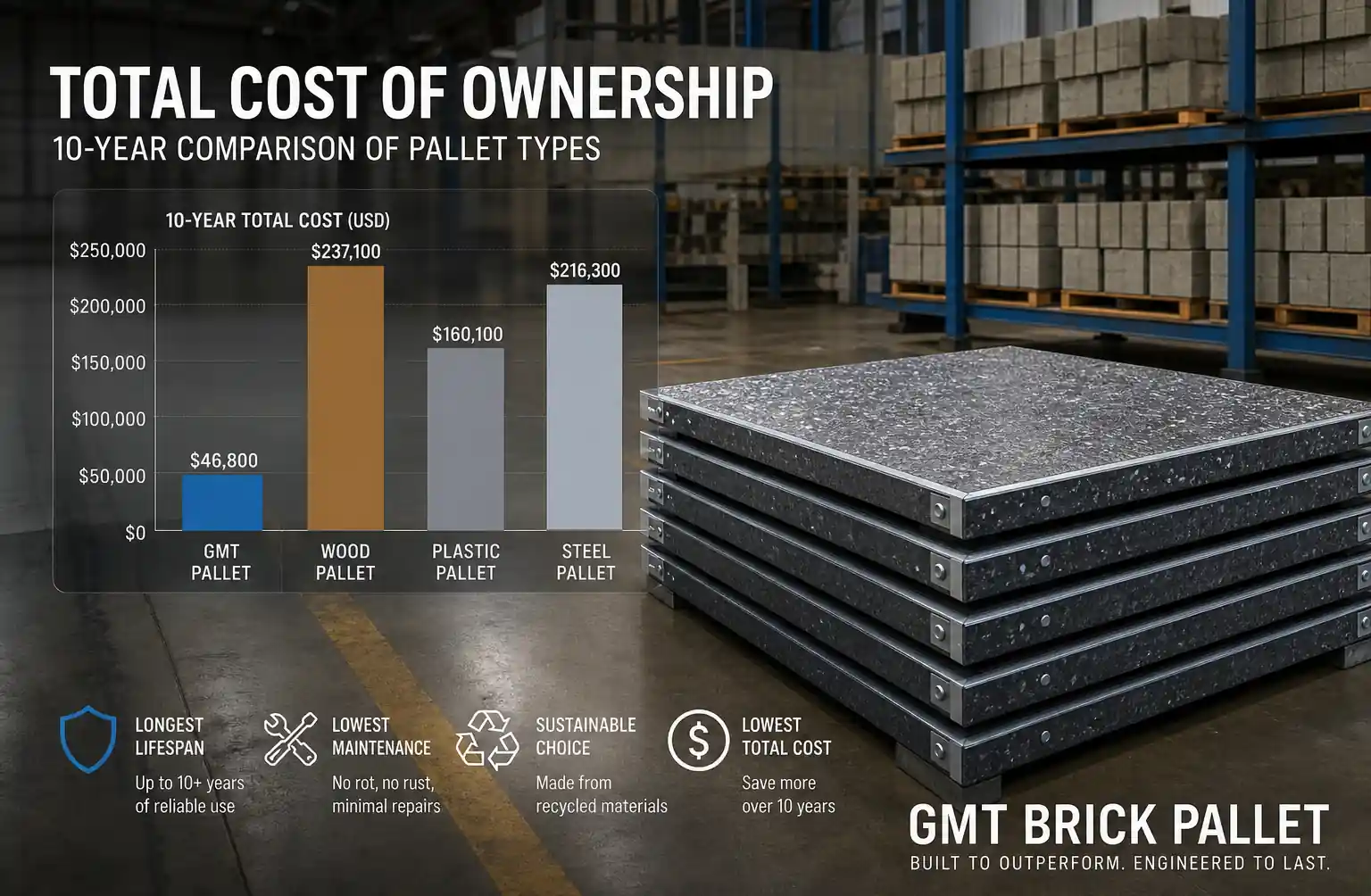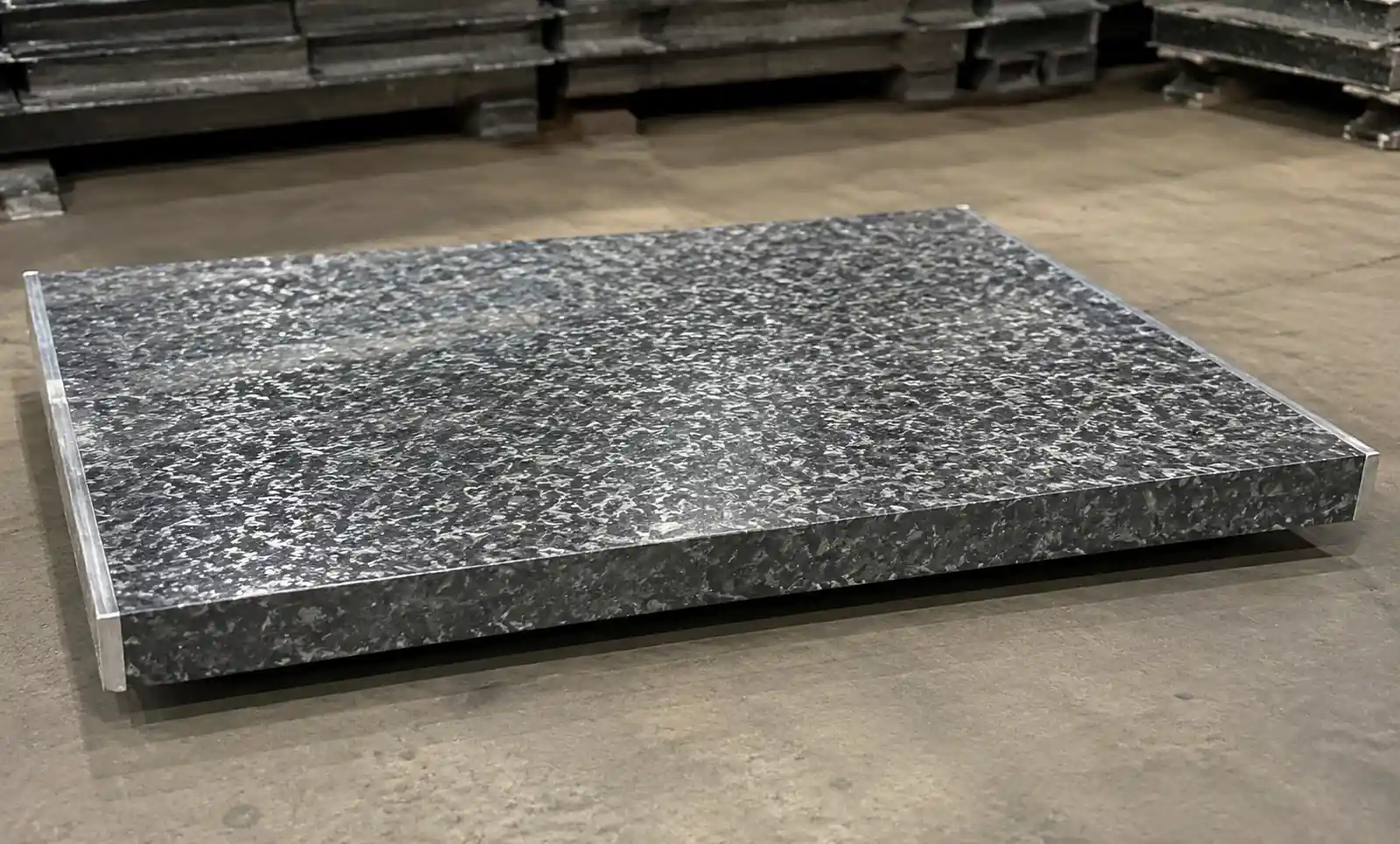
Pallet costs consume 12-18% of total production expenditure in concrete block facilities. Wood pallets deteriorate within 18-36 months, forcing endless replacement cycles. GMT pallets maintain structural integrity beyond 10 years, fundamentally changing production economics. This guide examines true lifecycle costs, replacement frequency impacts, productivity losses, and ROI over 5-10 year planning horizons.
Understanding Real Pallet Costs Beyond Purchase Price
Total cost of ownership includes acquisition, replacement, maintenance labor, downtime, quality losses, and disposal. Wood pallets appear economical at $20-35 per unit until you calculate replacement every 2-3 years plus 15-20 hours monthly maintenance for a 200-pallet operation.
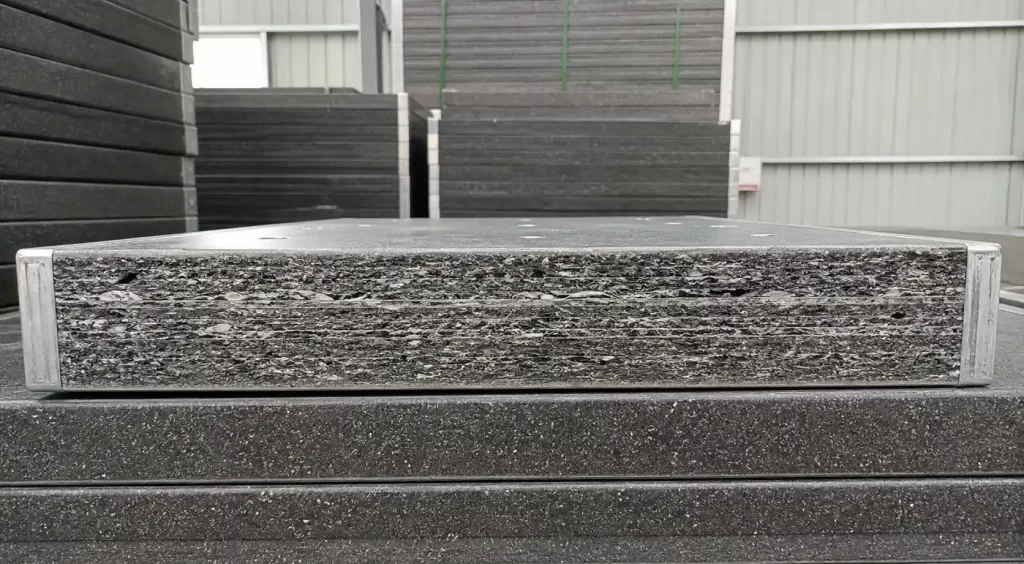
GMT pallets cost $85-135 per unit with near-zero maintenance and 10+ year service life. A 200-pallet wood inventory requires 500-700 total pallet purchases over 10 years at 30-35% annual attrition. The same GMT inventory needs 220-240 pallets total—eliminating 60-65% of replacement purchases.
Initial Investment Comparison
| Pallet Type | Unit Cost | 200-Unit Fleet Cost | Load Rating | Expected Lifespan | Annual Replacement Cost |
|---|---|---|---|---|---|
| Standard Wood | $20-35 | $4,000-7,000 | 2,200 kg | 18-30 months | $2,400-4,900 |
| Treated Wood | $40-55 | $8,000-11,000 | 2,500 kg | 24-36 months | $2,400-4,125 |
| Recycled Plastic | $65-95 | $13,000-19,000 | 2,300 kg | 5-7 years | $1,560-2,850 |
| GMT Composite | $85-135 | $17,000-27,000 | 2,800 kg | 10-12 years | $1,360-2,430 |
| Premium Fiber | $110-160 | $22,000-32,000 | 3,200 kg | 12-15 years | $1,540-2,240 |
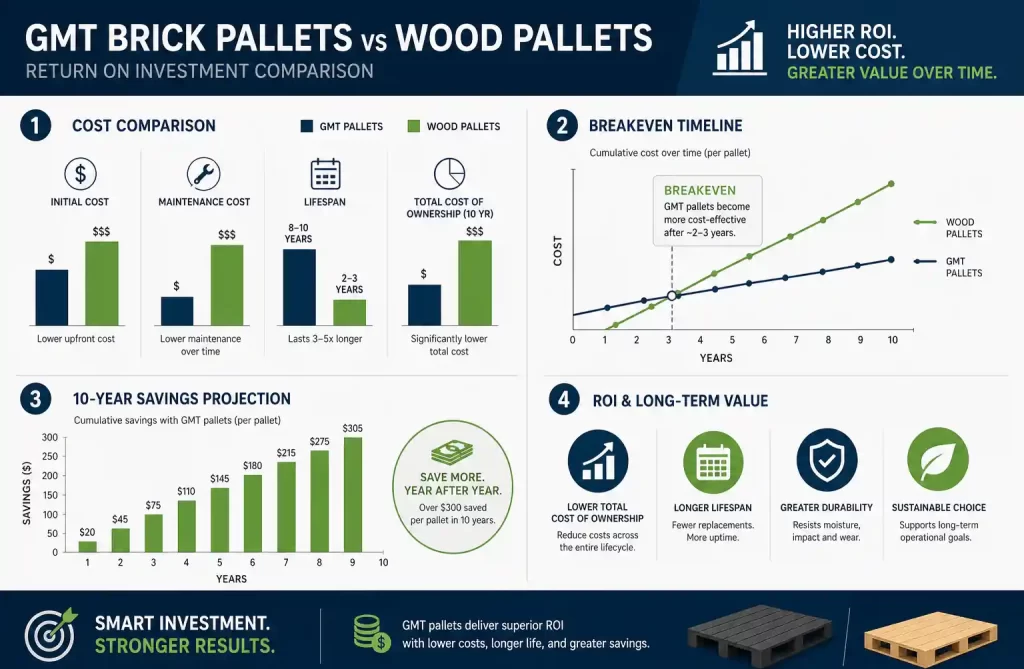
Wood’s low entry cost creates illusion of affordability. A $7,000 wood fleet becomes $31,000-49,000 in total purchases over 10 years. The $27,000 GMT fleet requires $40,800-48,600 total investment—15-18% lower total pallet expenditure.
Maintenance Requirements Drive Hidden Labor Costs
Wood pallets demand 12-20 hours weekly maintenance for 200-pallet inventory: visual inspection for cracks (5-8 hours), surface sanding (4-6 hours), dimensional checking (2-3 hours), disposal coordination (1-2 hours). At $25/hour, annual wood maintenance costs $7,800-13,000.
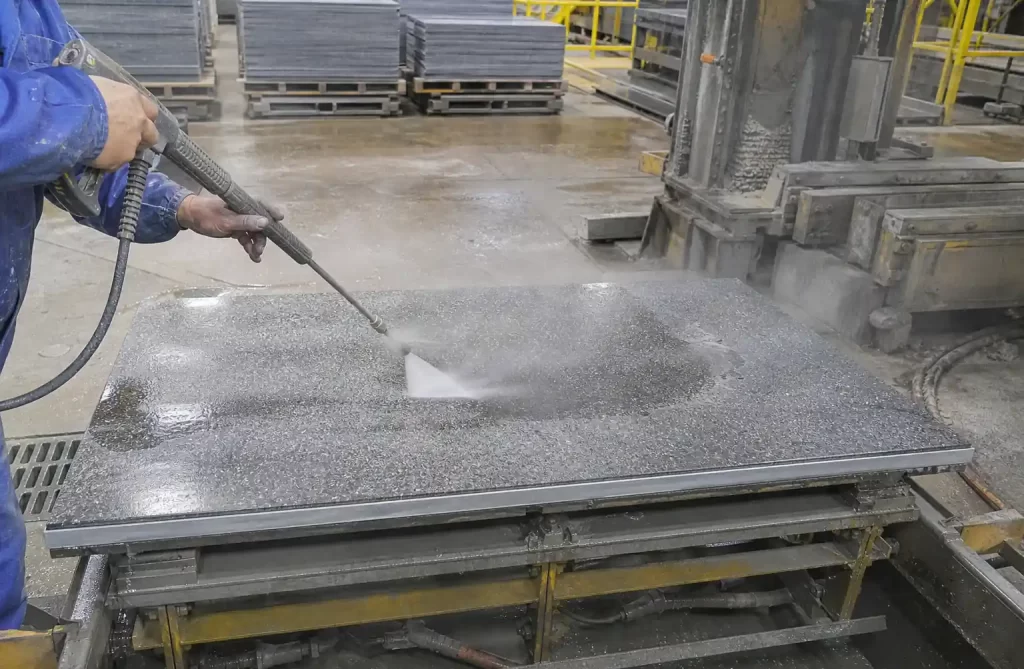
GMT pallets eliminate 80-85% of maintenance labor. The molded composite surface never splinters. Moisture absorption under 0.5% prevents dimensional changes. Monthly maintenance drops to 2-3 hours—annual labor $1,300-1,950.
Surface degradation in wood pallets increases block defects. Fiber-reinforced pallets maintain ±1.5mm surface flatness throughout service life, keeping block dimensional variation under control.
Lifespan Reality: How Long Pallets Actually Last
| Performance Metric | Wood (Standard) | Wood (Treated) | Plastic Composite | GMT Pallet | Fiber Premium |
|---|---|---|---|---|---|
| Typical Lifespan | 18-30 months | 24-36 months | 5-7 years | 10-12 years | 12-15 years |
| High-Volume Life | 12-24 months | 18-30 months | 4-6 years | 9-11 years | 11-14 years |
| Moisture Absorption | 12-18% | 8-12% | 2-4% | <0.5% | <0.3% |
| Dimensional Stability | ±4-6mm | ±3-5mm | ±2-3mm | ±1.5mm | ±1.0mm |
| Production Cycles | 2,000-4,000 | 4,000-6,000 | 12,000-18,000 | 25,000-35,000 | 30,000-45,000 |
Facilities in 70%+ humidity see wood lifespan drop 30-40%. GMT pallets maintain consistent performance across -25°C to +75°C with no humidity sensitivity.
Production Impact: Block Quality and Yield
Surface deterioration in wood pallets increases block defect rates by 15-25% after 8-12 months. Rough, splintered surfaces transfer irregularities to block bottoms. Warped surfaces create thickness variations of 2-5mm across batches.
GMT pallets maintain consistent quality throughout service life. Surface finish stays within ±0.5mm flatness. Zero moisture absorption prevents dimensional changes. Manufacturers report 40-55% reduction in bottom-face defects after GMT conversion.
GMT pallets weigh 15-22 kg versus 35-45 kg for wood—45-55% weight reduction. This accelerates forklift cycles by 8-12 seconds per move. With 800-1,200 daily pallet moves, you gain 1.8-4.0 hours productive capacity daily.
Automated lines require precise pallet dimensions. Wood variation ±3-5mm causes positioning errors. GMT pallets at ±1mm tolerance integrate seamlessly—production uptime improves 4-7%.
Calculating Your Breakeven Point
Example: 200-Pallet Operation
Initial investment: GMT $27,000 – Wood $7,000 = $20,000 additional capital
Annual replacement: Wood $2,240 – GMT $2,430 = -$190 (GMT costs slightly more)
Maintenance savings: Wood $13,000 – GMT $1,950 = $11,050
Productivity gains: Defect reduction $4,500 + Handling $3,800 + Uptime $2,200 = $10,500
Total annual benefit: $11,050 + $10,500 – $190 = $21,360
Payback: $20,000 ÷ $21,360 = 0.94 years (11.3 months)
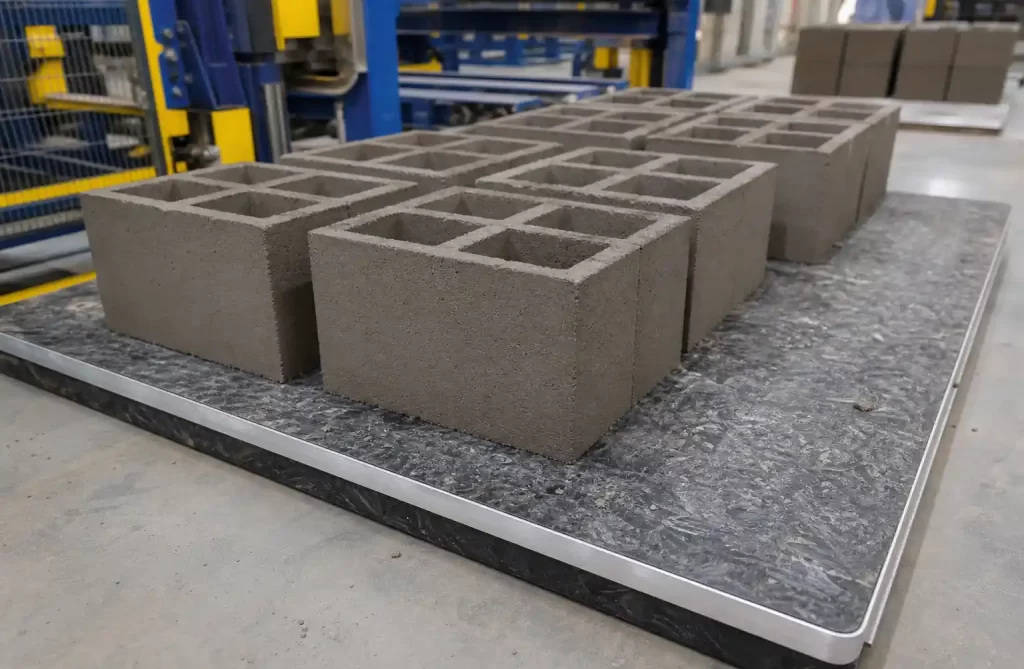
High-volume facilities (100,000+ blocks monthly) achieve 8-10 month payback. Smaller operations see 18-24 months but still excellent returns.
Total Cost of Ownership Over 10 Years
Wood Pallet TCO (200-unit inventory, 10 years):
- Initial purchase: $7,000
- Replacements: 630 pallets × $35 = $22,050
- Maintenance: $13,000 × 10 = $130,000
- Disposal: 730 pallets × $3 = $2,190
- Production losses: $2,800 × 10 = $28,000
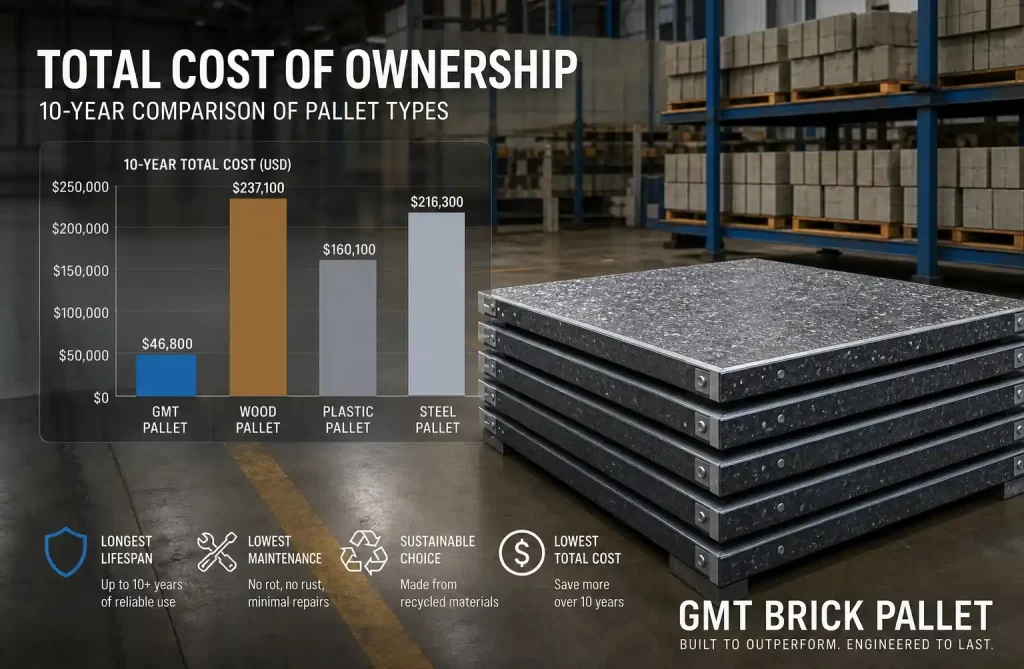
- Total: $189,240
GMT Pallet TCO (200-unit inventory, 10 years):
- Initial purchase: $27,000
- Replacements: 180 pallets × $135 = $24,300
- Maintenance: $1,950 × 10 = $19,500
- Disposal: 380 pallets × $1.50 = $570
- Production losses: $900 × 10 = $9,000
- Total: $80,370
GMT pallets deliver $108,870 savings (58% lower TCO) despite 3.9× higher initial investment—$10,900 average annual savings after breakeven.
ROI Framework for Your Operation
Step 1: Determine Required Pallet Quantity
(Daily Production ÷ Blocks per Pallet) × Cure Days × 1.15 = Required Quantity
Example: (2,500 ÷ 12.5) × 3 × 1.15 = 690 pallets
Step 2: Additional Capital
690 × ($135 – $35) = $69,000
Step 3: Annual Replacement Savings
(690 × 32% × $35) – (690 × 9% × $135) = -$660
Step 4: Maintenance Labor Savings
(18 hrs × 52 × $28) – (3.6 hrs × 52 × $28) = $20,966
Step 5: Productivity Benefits
Defect reduction ($0.45 × 50% × 750,000) + Handling (10 sec × 900 × 250 ÷ 3600 × $28) + Uptime (80 hrs × 320 × $0.35) = $195,210
Step 6: ROI and Payback
Annual benefits: -$660 + $20,966 + $195,210 = $215,516
ROI: $215,516 ÷ $69,000 = 312% first-year return
Payback: $69,000 ÷ $215,516 = 0.32 years (3.8 months)
Contact Rhinos Pallet for customized ROI analysis.
Critical Decision Factors
Production Volume: High-volume (80,000+ blocks/month) benefits most—8-10 month payback. Mid-volume: 12-18 months. Low-volume: consider phased conversion starting with 30-40% GMT.
Automation Level: Automated lines demand precise dimensions only composites provide. Plan GMT now if automating within 3-5 years.
Climate: High-humidity facilities should prioritize GMT—wood performance deteriorates 35-50% faster in 70%+ humidity.
Capital: Phased conversion over 2-4 years spreads investment. Finance through leasing or working capital facilities.
FAQ
What is the actual lifespan difference between wood and GMT pallets?
Wood pallets last 18-36 months with proper maintenance; GMT pallets deliver 10-14 years. High-volume operations reduce wood to 12-24 months, while GMT still achieves 9-11 years.
How long to recover the higher investment in GMT pallets?
Typical 200-pallet operations achieve 11-14 month payback. High-volume facilities: 8-10 months. Smaller operations: 18-24 months.
Do GMT pallets reduce block defects?
Data shows 40-55% reduction in bottom-face defects after GMT adoption. Consistent surface flatness (±1.5mm) prevents irregularities wood develops over time.
Can I mix wood and GMT pallets in the same line?
Yes but dimensional differences create challenges. Wood varies ±3-5mm; GMT maintains ±1mm. Automated systems require consistency—mixing works better in manual operations.
What maintenance do GMT pallets require?
Simple cleaning to remove concrete residue—compressed air or water spray taking 45-75 seconds per pallet. Monthly maintenance drops to 2-3 hours for 200 pallets versus 12-20 hours for wood.
Conclusion
Concrete block pallet cost analysis demonstrates initial purchase price represents only 15-25% of true lifecycle expenses. GMT pallets cost 3-4× more initially but deliver 5-7× longer service life, 80-85% lower maintenance, and 40-55% better block quality. TCO analysis shows 55-60% lower total ownership costs over 10 years. ROI calculations for typical operations show 11-14 month payback and 90-120% first-year returns.
If you need long-lasting concrete block pallets, Rhinos Pallet manufactures fiber-reinforced GMT pallets with proven 10+ year lifespan. Our moisture-resistant construction, precision ±1mm tolerance, and comprehensive testing ensure consistent quality. Contact us today for customized pallet solutions, detailed ROI analysis, and factory-direct pricing.