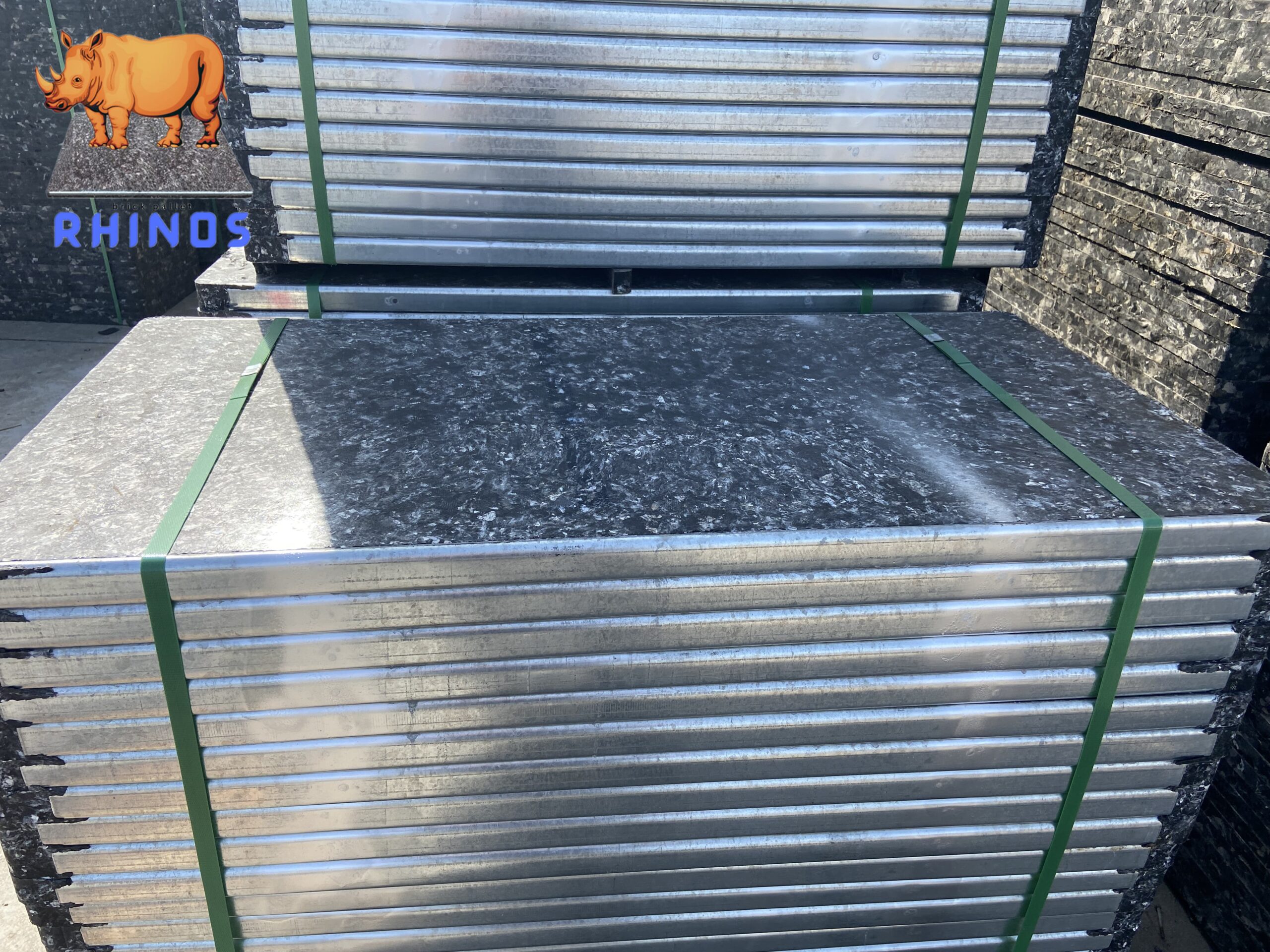
Brick production facilities lose $12,000-28,000 annually per 100 pallets when using traditional wood alternatives. Warped pallets trigger line stops, moisture-swollen boards mark premium bricks, and replacement cycles eat into margins every 24-36 months. GMT pallets eliminate these costs through glass fiber reinforcement that maintains dimensional stability across 10+ year production cycles.
If you’re evaluating pallet upgrades for automated lines or fighting moisture issues in high-humidity plants, understanding GMT technology helps you avoid costly mistakes when switching from wood.
What Does GMT Stand For? The Material Science
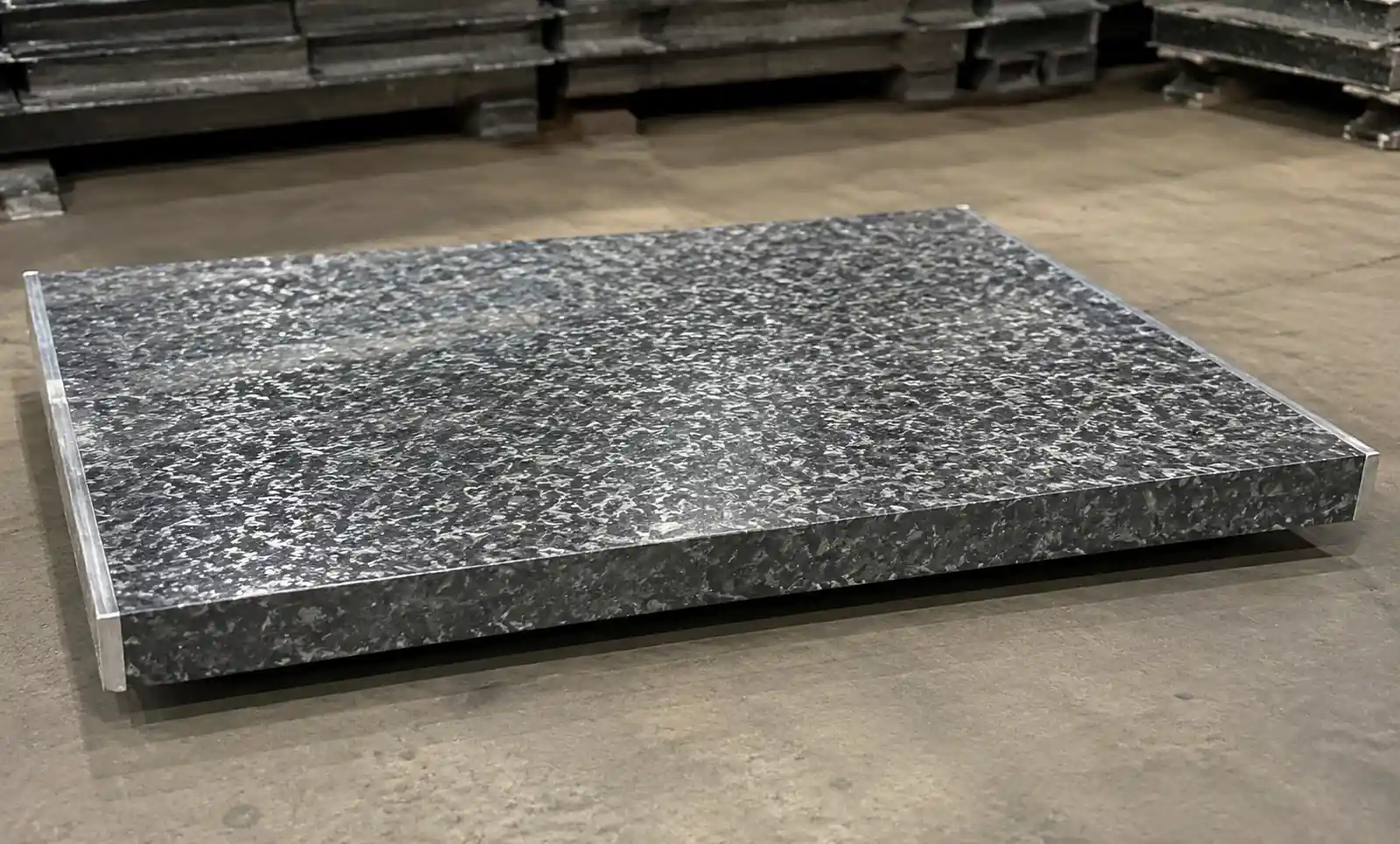
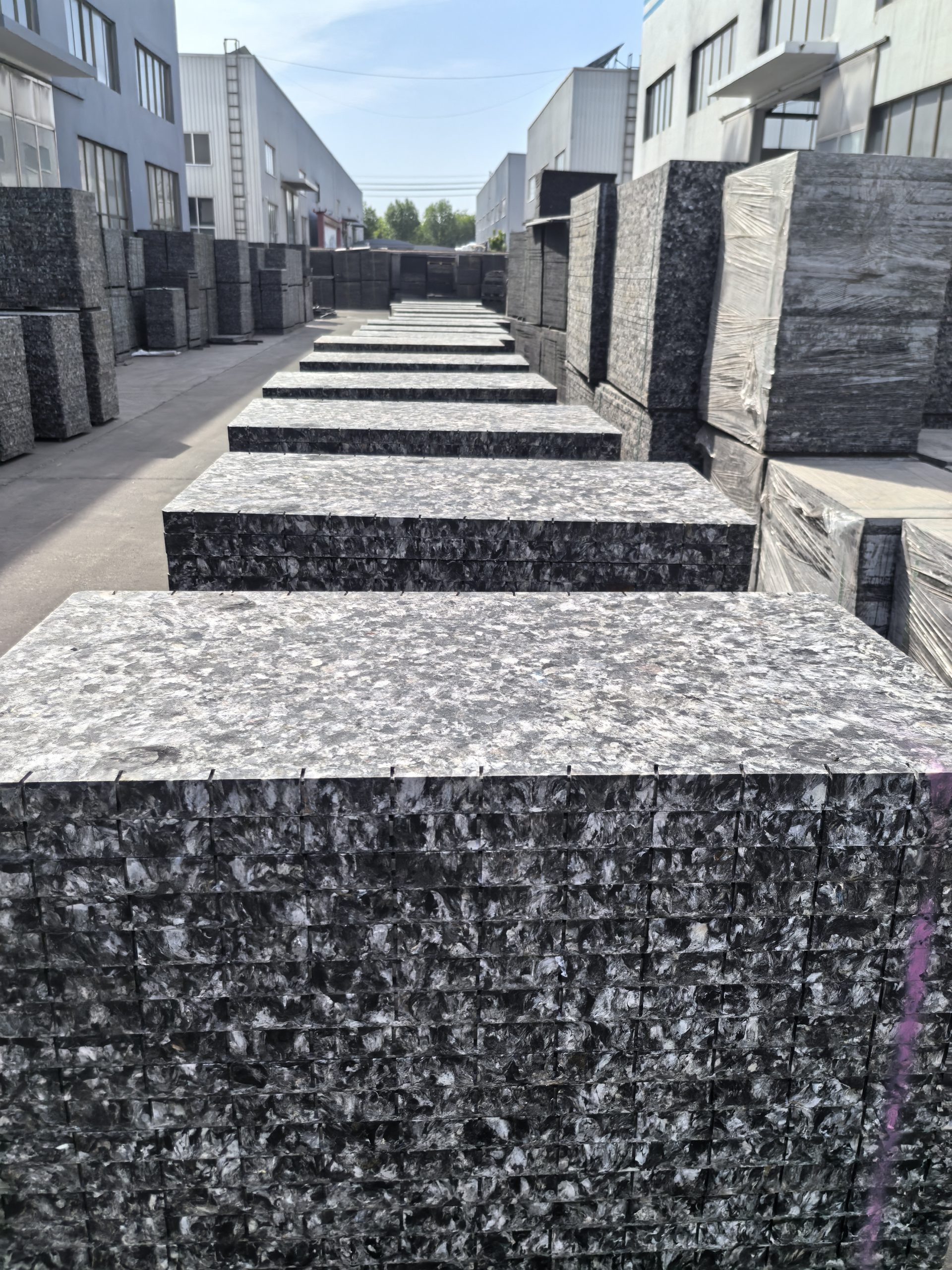
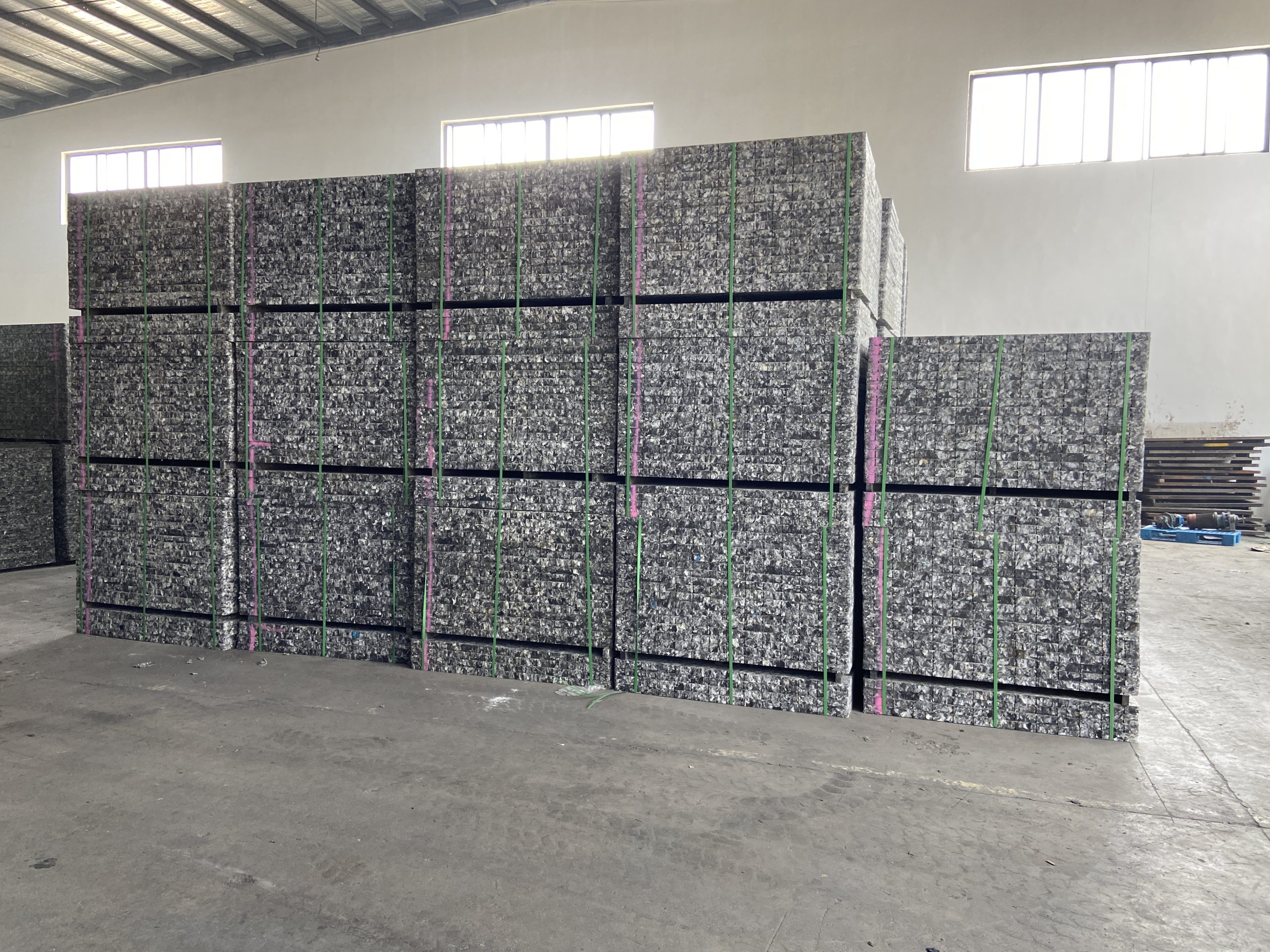
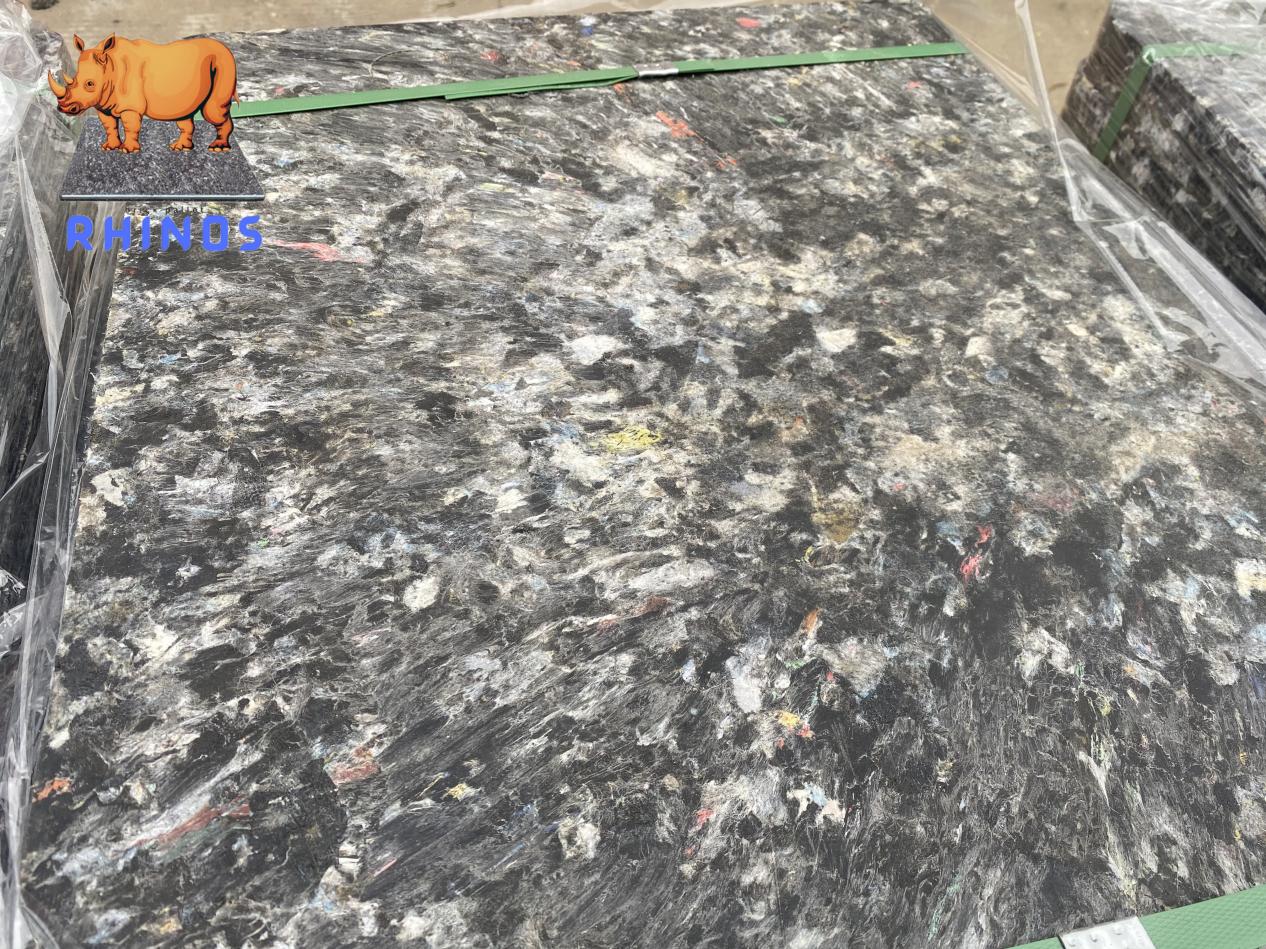
GMT means Glass Mat Thermoplastic – a compression-molded composite where continuous glass fiber mats (30-50% by weight) are embedded in polypropylene resin under heat and pressure. The glass provides the structural backbone, while the thermoplastic matrix allows remelting and reforming.
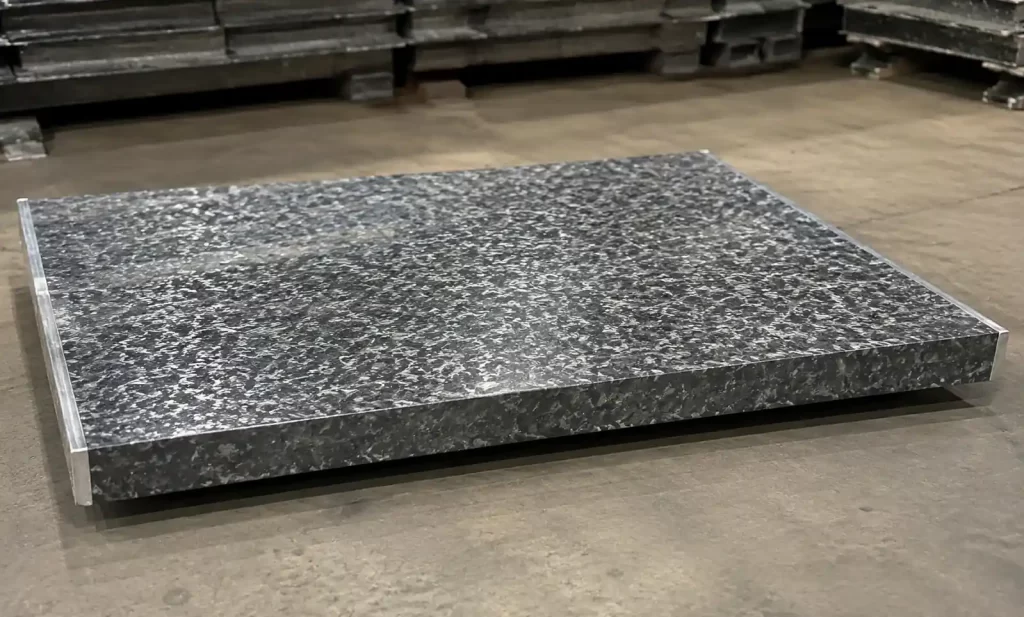
Manufacturing: Glass fiber mats are layered with polypropylene sheets, then compressed at 180-220°C under 50-100 bar pressure. The resulting pallet weighs 15-25 kg but supports 2,500-3,500 kg static loads. Moisture absorption stays below 1% – wood swells 15-20% in humid environments.
Why Brick Manufacturers Switched
Most plants switched after calculating downtime costs. With automated lines running 18-22 hours daily, every pallet-related stoppage costs $150-400. Wood pallets create three predictable failure modes:
Moisture warping changes pallet dimensions by 3-8mm within 12-18 months in high-humidity environments. Sensors flag positioning errors, triggering safety shutdowns.
Surface degradation from concrete contact creates rough spots that mark premium bricks. GMT’s molded surface stays smooth across 10,000+ production cycles.
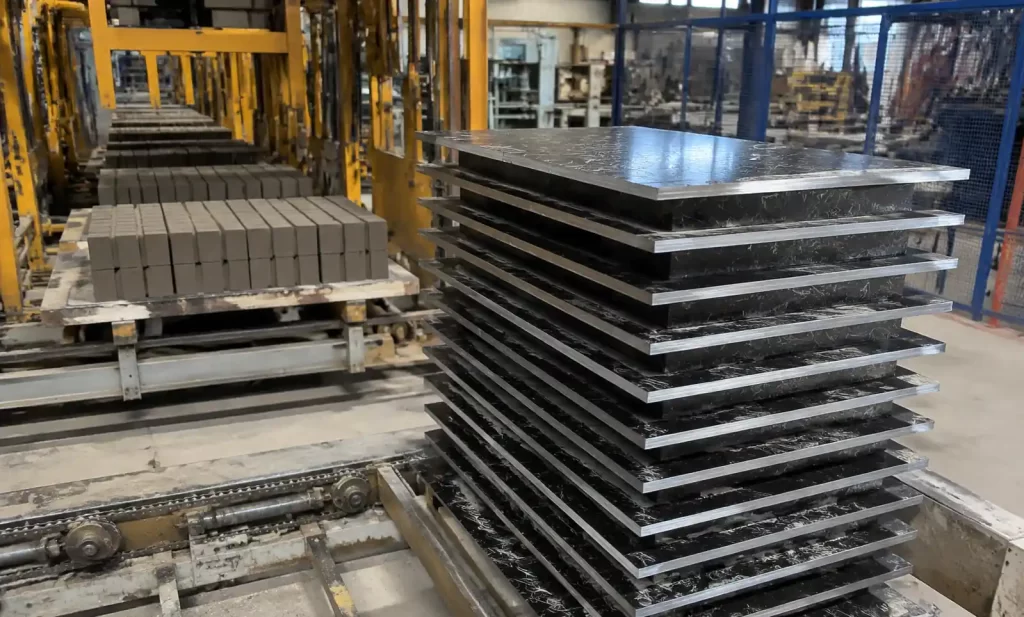
Structural failure – a board cracks during handling, bricks drop, and you’ve got cleanup plus replacement downtime. GMT’s fiber reinforcement prevents catastrophic failures.
Initial cost runs 3-4× higher than wood, but replacement frequency drops 80%. Most plants hit breakeven at 18-24 months.
GMT Pallet Types and Selection Guide
Pure white GMT pallets use 100% virgin polypropylene resin with no recycled content – maximum UV stability for outdoor storage and zero contamination risk. Pure white GMT delivers 12-15 years in demanding environments.
Standard GMT pallets blend virgin and recycled thermoplastic (60-70% virgin). High-quality GMT options perform identically for most applications while reducing costs 15-25%.
Precision-molded pallets maintain ±1mm dimensional tolerance throughout service life. Premium white GMT is specified for automated lines processing 60-120 bricks per minute.
Climate-adapted variants handle extreme conditions – enhanced moisture barriers for 85-95% RH, heat-resistant formulations from -40°C to +100°C. Black glass fiber pallets add extra reinforcement for loads exceeding 3,000 kg.
Half-size pallets reduce material costs 45-50% while maintaining identical specifications. Half GMT pallets work well for facilities producing multiple brick sizes.
Material Composition: What Actually Matters
Glass fiber content directly determines pallet rigidity. Continuous strand mats deliver superior properties versus chopped fiber because fiber lengths exceed 100mm. Specify minimum 35% glass content for demanding brick production applications.
The thermoplastic matrix affects long-term durability. Polypropylene dominates for specific reasons: moisture absorption below 0.4%, chemical resistance to concrete’s alkaline environment, and impact strength surviving forklift abuse from -30°C to +80°C.
A GMT pallet with 35% glass content and quality resin outperforms a 50% glass pallet using inferior materials.
GMT vs Wood: Performance Data
| Performance Factor | GMT Pallet | Wood Pallet | Real-World Impact |
|---|---|---|---|
| Operational Lifespan | 10-12 years | 2-3 years | 4-5× fewer replacements |
| Moisture Absorption | <1% | 15-20% | Eliminates swelling/warping |
| Dimensional Stability | ±2mm for life | ±5-8mm after 12 months | Prevents sensor errors |
| Load Capacity | 2,500-3,500 kg | 1,500-2,500 kg | Handles heavier blocks |
| Weight Consistency | ±0.5 kg | ±3-8 kg | Enables automated optimization |
| Surface Flatness | ±2mm maintained | ±5-8mm develops | Reduces brick marking by 60% |
| Temperature Range | -30°C to +80°C | -10°C to +50°C | All-climate operation |
Moisture stability matters more than specifications suggest. Humidity swings of 40-85% RH caused wood pallets to dimension-shift by 6mm over 48 hours. GMT pallets showed zero measurable change.
Technical Specifications
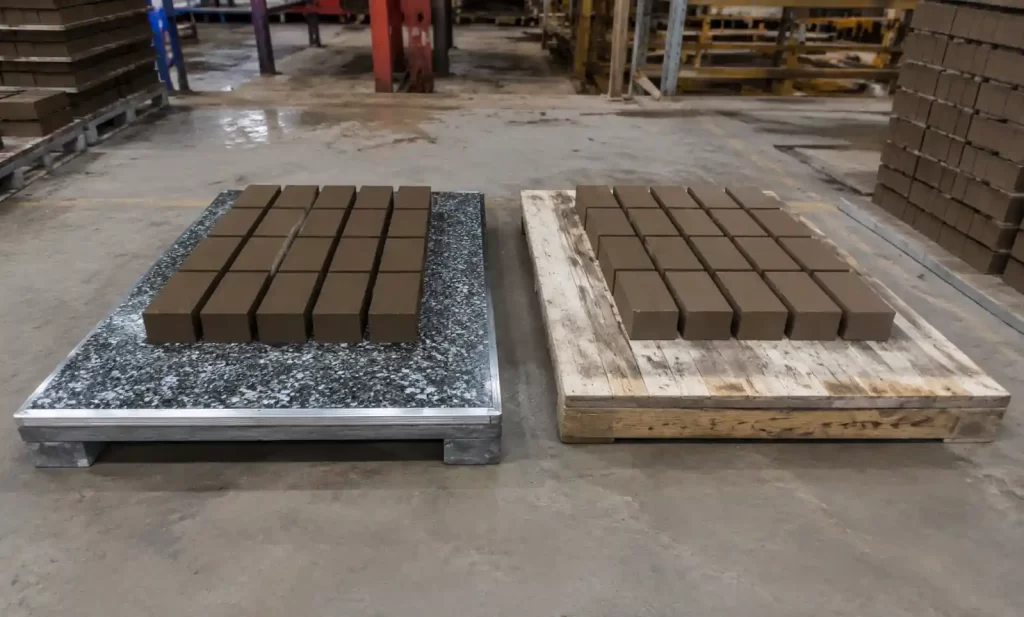
Standard GMT brick pallets measure 850mm × 680mm × 15-25mm thickness. Load capacity ranges from 2,500-3,500 kg static – adequate for typical brick loads of 1,800-2,400 kg.
| Specification | Standard Industrial | Premium Automated | Critical for |
|---|---|---|---|
| Dimensions (L×W) | 850mm × 680mm | 850mm × 680mm | Fitting standard equipment |
| Thickness | 15-25mm | 20-30mm | Load capacity requirements |
| Weight Range | 15-25 kg | 20-30 kg | Handling equipment capacity |
| Static Load Capacity | 2,500-3,000 kg | 3,000-3,500 kg | Heavy concrete block production |
| Surface Flatness Tolerance | ±2mm | ±1mm | Automated positioning accuracy |
| Dimensional Tolerance | ±3mm | ±1mm | Robotic handling systems |
| Moisture Absorption (24hr) | <1% | <0.5% | High-humidity environments |
| Operating Temperature | -30°C to +80°C | -40°C to +100°C | Extreme climate operations |
| Expected Service Life | 10-12 years | 12-15 years | Replacement cost planning |
Weight consistency matters for automated operations – specify ±0.5kg tolerance for robotic handling systems.
Application-Specific Insights
Automated brick making machines require pallets maintaining ±1mm tolerance. Fiber brick pallets and yellow fiber options deliver this consistency.
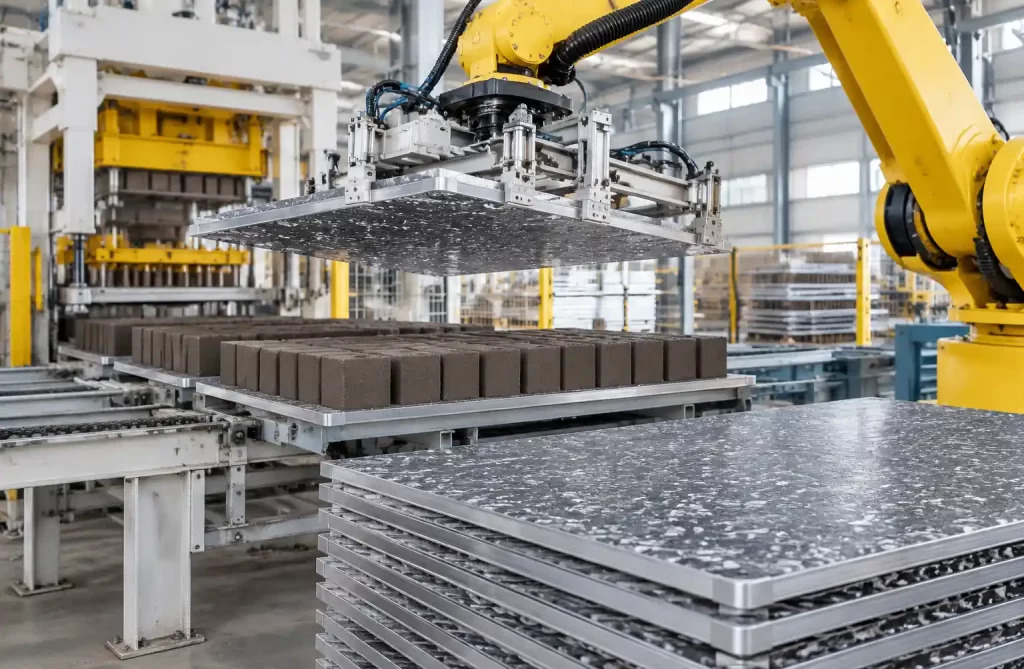
Concrete block production generates heavier loads (3,000-3,500 kg) in alkaline environments (pH 12-13). GMT’s chemical resistance maintains integrity across 10,000+ cycles – plants report 35-45% reduction in block defects.
High-humidity environments (75-95% RH) cause wood pallet failures within 12-18 months. White-yellow GMT pallets maintain specifications for 10+ years.
Multi-format production lines benefit from half-size GMT pallets that reduce changeover complexity.
Cost Reality: Investment vs Total Ownership
Initial GMT investment runs $80-120 per unit for standard grades and $100-150 for precision-molded versions, compared to $20-35 for wood.
For a 500-pallet facility over 10 years:
- Wood pallets: $10,000-17,500 initial + $70,000-120,000 replacements + $25,000-35,000 maintenance = $105,000-172,500 total
- GMT pallets: $40,000-60,000 initial + $5,000-10,000 replacements + $5,000-8,000 maintenance = $50,000-78,000 total
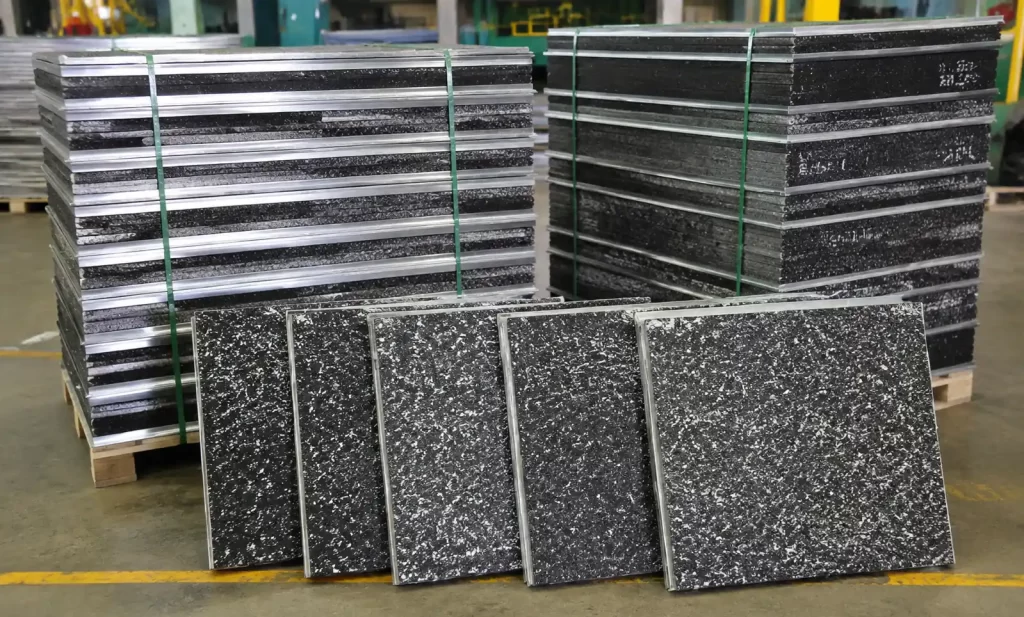
Breakage reduction alone often justifies the investment. GMT reduces brick breakage 40-60% by maintaining flat surfaces. For a facility producing 2 million bricks annually at $0.45 average value with 10% breakage, reducing to 5% saves $45,000 annually.
Integration Strategy
Start with 100-150 GMT pallets on your automated line where dimensional consistency delivers immediate throughput improvements. Monitor for 6-12 months, then expand to manual operations as wood pallets reach end-of-life.
Convert sections with highest downtime costs first – typically automated handling. Manual areas can continue using wood temporarily.
Mixing wood and GMT pallets works in manual operations but causes problems on automated lines. If mixing, segregate by production area.
Regional Considerations
High-humidity environments (Southeast Asia, India): GMT maintains specifications indefinitely; wood fails within 14-18 months.
Temperature extremes (Middle East, North Africa): 40-50°C ambient accelerates wood degradation; GMT operates normally.
Cold climates (Northern Europe, Canada): Specify impact-modified polypropylene maintaining toughness below -20°C.
FAQ
What makes GMT different from regular plastic pallets?
GMT uses continuous glass fiber mat reinforcement through compression molding. Regular plastic pallets use injection-molded polypropylene or HDPE without fiber reinforcement. The continuous glass fibers give GMT superior load capacity (2,500-3,500 kg vs 1,500-2,000 kg), better dimensional stability, and longer service life.
How long do GMT pallets last in high-volume production?
Real-world data shows 10-12 years for standard grades and 12-15 years for premium versions. Facilities running three shifts daily report GMT pallets from 2012 still maintaining original dimensions within ±2mm. Lifespan depends on handling practices – forklift abuse reduces service life regardless of pallet type.
Can GMT pallets handle the alkaline environment from fresh concrete?
Yes. Polypropylene resists alkaline attack (pH 12-13) that accelerates wood deterioration. Plants producing 50,000+ blocks monthly report no measurable degradation of GMT pallet surfaces after 8-10 years of continuous concrete contact.
What’s the real payback period for switching from wood to GMT?
Most facilities achieve positive ROI within 18-26 months when accounting for replacement cost savings, reduced maintenance, lower defect rates, and improved uptime. High-volume operations (50,000+ bricks monthly) hit breakeven faster. Lower-volume facilities under 10,000 bricks monthly may see 30-36 month payback.
Can GMT pallets be recycled at end of life?
Yes – thermoplastic polypropylene can be remelted and reformed. Some manufacturers accept end-of-life GMT pallets for reprocessing. The long 10-12 year service life means recycling considerations arise infrequently compared to wood pallets needing disposal every 2-3 years.
Conclusion
GMT pallets deliver measurable advantages over wood – 10-12 year lifespan, moisture absorption below 1%, dimensional stability within ±2mm, and load capacity of 2,500-3,500 kg. Total ownership costs run 40-60% lower than wood over 10 years, with most facilities achieving ROI within 18-26 months. If you need long-lasting brick pallets, Rhinos Pallet offers GMT solutions with 10+ year lifespan for automated and manual operations. Contact us today for custom pallet solutions and factory-direct pricing.